Premade Cabinets: A First-Time Buyer's Guide
The cabinet page that confuses first-time buyers is rarely about the cabinet. It is about the words: RTA, overlay, face frame, dovetail, filler. CasaBuilt's basic six-cabinet kitchen is listed at $1,184.93 in Hudson Grey and $1,199.50 in White Shaker, and every one of those terms appears somewhere in the listing that describes it. This guide translates the vocabulary and then puts the steps in order.
Key takeaways
- RTA means ready to assemble and arrives flat-packed; assembled cabinets arrive closed and ready to hang.
- A door sample costs $9.99 and the fee is refundable with a cabinet purchase.
- Free 3D design is delivered in 24-48 hours; RTA orders ship in 3-10 business days.
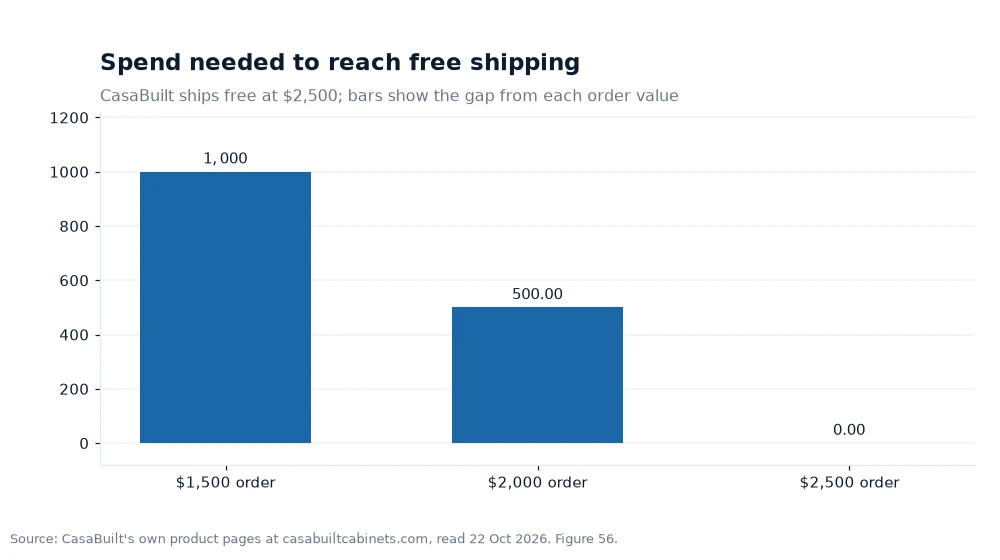
- Free shipping starts at $2,500, so a $1,500 order is $1,000 away from the line.
The words on the spec sheet
Start with the box. The carcase is the cabinet without its door: two sides, a back, a bottom, a top and shelves. CasaBuilt lists a 1/2-inch birch plywood box with a natural birch interior and color-matched exterior sides. Plywood means layers of wood, which is why the thickness is stated in inches rather than described as a board.
The face frame is the frame at the front of the carcase, and CasaBuilt lists it at 3/4 inch by 1-1/2 inch solid birch. A framed cabinet has one; a frameless cabinet does not, which is why frameless doors cover more of the opening. Full overlay describes a door that sits over the frame rather than inside it, so the gap between doors is small and the frame is mostly hidden.
Dovetail is a joint, not a decoration. The drawer sides interlock with the front in a series of angled pins, and CasaBuilt lists 5/8-inch rubberwood drawers with dovetail joints. Soft-close means a hinge or glide that slows the last inch of travel instead of letting the door or drawer land. Undermount means the glide sits under the drawer rather than on its side. Six-way adjustable means the hinge can be corrected in several directions after installation, which is the single most useful feature in the list for a first-time buyer.
The order sequence, step by step
The published process runs in five stages: explore styles, order samples, submit measurements for a quote, design and purchase, then install. That order is not arbitrary. Samples before measurements stops a buyer falling for a finish that does not suit the room. Measurements before design stops a plan being drawn around a wall nobody has checked. Design before purchase stops a cart being filled with cabinets that do not fit together.
Step one takes an evening. Step two takes a few days for delivery. Step three is the one people rush, and it is the one that decides whether the kitchen fits. Measure the wall at counter height and at cabinet height, note the ceiling, the window positions and every appliance width, then send those numbers in. CasaBuilt's free 3D design arrives in 24-48 hours, which is fast enough to catch a mistake before the order rather than after.
The sample step is cheap and worth doing properly. CasaBuilt lists its premade cabinets by collection and keeps sixteen door samples in stock at $9.99 each, with the fee refundable against a cabinet purchase, plus two premium finishes priced separately at $19.50 and $22.00. Look at the sample in the room at the time of day the kitchen is busiest. A white that looks warm under a shop light can look gray against a north-facing wall.
What the standard sizes mean for a first plan
Base cabinets are 34-1/2 inches high and 24 inches deep, in widths from 9 to 42 inches. Wall cabinets are 12 inches deep, in heights of 30, 36 and 42 inches, and widths from 9 to 39 inches. Vanity cabinets keep the base height but reduce the depth to 21 inches, with widths from 12 to 48 inches. Those three sentences describe most of what a first plan needs to know.
A first plan usually starts with the sink. A sink base is 30 to 36 inches wide, and it sets the centerline for the run. The range goes next, then the refrigerator, and the remaining inches are filled with base cabinets from the stock list. Wall cabinets follow the same logic around the window and the hood. Anyone who plans the appliances first will find the cabinet list falls out of the plan; anyone who plans the cabinets first will find the appliances do not fit.
The words that appear at the end of a plan are filler and panel. A filler is a narrow strip that closes the gap between the last cabinet and the wall. A panel is a finished board on an exposed side, such as the end of a peninsula. Neither is expensive, both are visible, and both should be on the list before the order rather than discovered during installation.
What each step costs and how long it takes
The table collects the published numbers that a first-time buyer meets in the first month. None of them is a quote for a kitchen; they are the fixed points around which a quote is built. Read the right-hand column as what to expect rather than what to demand, since a ship window is a window and not a promise.
| Step | What happens | Published figure |
|---|---|---|
| Sample | A door front arrives to inspect the finish | $9.99, refundable with a cabinet purchase |
| Design | A 3D plan is drawn from your measurements | 24-48 hours |
| RTA shipping | Flat-packed cabinets leave the warehouse | 3-10 business days |
| Assembled shipping | Closed cabinets leave the warehouse | Within two weeks |
| Freight | Shipping charge disappears above the threshold | Free from $2,500 |
| Warranty | Cover against manufacturing defects | One year, normal residential use |
Two rows deserve a second look. The warranty covers manufacturing defects in materials and workmanship, not installation damage, so the first week is the time to inspect every door and drawer. The freight row is the one that changes an order total most often, because a plan that lands just under $2,500 pays shipping on the whole shipment.
Worked example: the last thousand dollars
The chart states three gaps: $1,000 still needed on a $1,500 order, $500 on a $2,000 order, and $0 on a $2,500 order. Check each against the threshold. $2,500 minus $1,000 returns $1,500. $2,500 minus $500 returns $2,000. $2,500 minus $0 returns $2,500.
The steps are even because the orders are: $2,000 minus $1,500 is $500, and $1,000 minus $500 is also $500. As a share of the order, the $1,000 gap is 67% of a $1,500 order, while the $500 gap is 25% of a $2,000 order. The smaller the order, the more of it is missing.
Convert the gap into cabinets and it becomes concrete. At the published $238.24 for a 9-inch to 21-inch single-door base, $1,000 buys four 15-inch bases for $952.96 with $47.04 left — 60 inches of base cabinet added to the plan. The $500 gap buys two of the same base for $476.48 with $23.52 left, which is 30 inches. A first-time buyer who is close to the threshold can therefore close it with real storage rather than with an accessory.
Frequently asked questions
Do I need to assemble RTA cabinets myself?
RTA cabinets arrive flat-packed with the hardware and step-by-step guides in the box, and the company publishes assembly videos and support. A buyer who is comfortable with a screwdriver can build them; a buyer who is not should compare the assembled line, which is quoted at within two weeks and arrives ready to hang.
Is the design service really free?
Nothing is charged for it. A 3D kitchen plan comes back in 24-48 hours, and trade customers are quoted room designs in less than 72 hours. What the plan cannot fix is the input: wall lengths, ceiling height and appliance widths have to be measured by the buyer, and an error there becomes an error in the drawing. The service is explained on the design consultation page.
How many samples should a first-time buyer order?
Two or three finishes is usually enough to make a decision, and each sample is $9.99 with the fee refundable against a cabinet purchase. Order the one you are most likely to choose plus one contrast, then look at both in the room at the time of day the kitchen gets used.
Start with a measurement, not a photograph
Write the wall lengths, ceiling height and appliance widths on one sheet of paper, and keep that sheet for the life of the kitchen. Choose two or three finishes and order the samples before committing to a style. Then run the plan through the design service, check that the total clears $2,500 if freight matters, and place the order with the fillers and panels included. The vocabulary stops being confusing once the sequence is clear.
Figures quoted here come from the manufacturer's own website, read 22 Oct 2026[1].